Braces or Jaw Surgery? How to Tell a Dental Bite Problem from a Skeletal One
David Lin · Updated 30 Jul 2026 · 8 min read

"Can braces fix this?" — the answer depends on whether the problem sits in the teeth or in the jawbones. Crooked, crowded or tilted teeth on normally positioned jaws are an orthodontic problem, and braces handle them. But when the jawbones themselves differ in size or position, moving teeth cannot fully compensate, and surgically repositioning the jaw may be required. Telling the two apart is not something a mirror can do — it takes formal skeletal analysis.
Braces or jaw surgery — what is the actual difference?
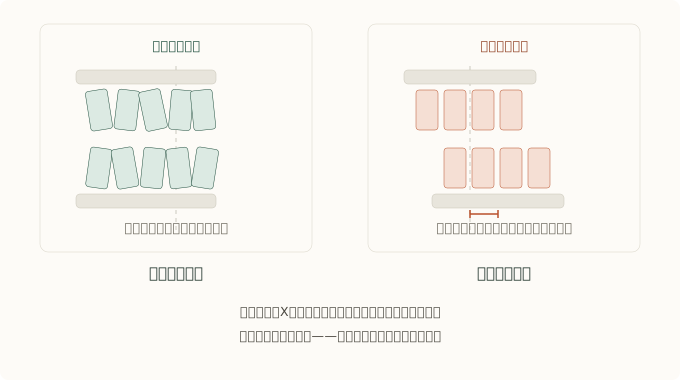
The simple distinction: braces move teeth; orthognathic surgery moves jawbones. In dental malocclusion — crowded, tilted or rotated teeth on normally positioned jaws — orthodontics alone does the job. In skeletal malocclusion — an underbite from an overgrown lower jaw, severe protrusion from the skeletal base, or a visibly asymmetric face — the problem sits at the level of the facial skeleton, and no amount of tooth movement fully compensates. Clinically, the distinction is made with cephalometric X-ray analysis, dental models and facial assessment; it cannot be self-diagnosed in a mirror and needs specialist evaluation. For the tooth-movement side of the picture, see our adult orthodontics guide — this article focuses on the cases where bone must move.
How do I know if my problem is skeletal?
Raise the question "is this skeletal?" at an orthodontic consultation if any of these apply: the lower front teeth bite in front of the upper ones (underbite); the front teeth cannot meet at all (open bite); the face or chin is visibly asymmetric; protrusion severe enough that a dentist has already said braces may not fully correct it; or previous orthodontic treatment that kept relapsing. The answer will not automatically be surgery — many borderline cases are managed with orthodontic compensation — but whether surgery is indicated can only be answered by formal skeletal analysis, never by an article.
What does jaw surgery actually treat? Is it cosmetic?
Medically, orthognathic surgery is functional treatment. Its core targets are:
- Chewing — bites that do not meet, open bites, or severe discrepancies that make eating inefficient and overload individual teeth
- Speech — certain sounds are hard to articulate with particular jaw and tooth positions
- Joint loading — a chronically asymmetric bite may add strain to the jaw joints and muscles (joint problems in their own right are covered in our TMJ guide)
- The airway — in cases with a set-back lower jaw, advancing the jaws can increase upper-airway space. Specific orthognathic procedures have been studied as treatment for selected cases of obstructive sleep apnoea, but suitability and expected benefit must be assessed jointly by sleep physicians and the surgical team; it is not appropriate for everyone and should not be regarded as a cure
Facial change is one consequence of surgery, but in a proper assessment function comes first. Jaw surgery performed purely for appearance involves a different set of considerations and consent discussions.
What does the full pathway look like, and how long does it take?
Orthognathic treatment is a three-act sequence — braces, surgery, braces — typically spanning around two to three years depending on complexity:
- Assessment and planning — cephalometric X-rays or 3D imaging, models or digital scans, and facial records; the orthodontist and the oral and maxillofacial surgeon plan the jaw movements together
- Pre-surgical orthodontics (commonly around 12–18 months) — the teeth are first aligned correctly on their respective jaws. The bite often temporarily looks and feels worse during this phase — that is expected, because the teeth are being positioned for where the jaws will be, not where they are
- Surgery — performed under general anaesthesia, with incisions usually inside the mouth; the jaws are repositioned as planned and fixed with titanium plates. Hospital stays vary; several days is common
- Post-surgical orthodontics (commonly around 6–12 months) — fine-tuning the bite to stability
- Retention — as with any orthodontic treatment, long-term retainer wear is required
The specialist video series below walks through the pathway stage by stage — assessment, surgery and recovery — and is worth watching in full if you are weighing this up.
Which specialists are involved — and why is it always a team?
At minimum two specialties: oral and maxillofacial surgery performs the operation, and orthodontics handles the tooth movement before and after — half the success of the surgery is decided by whether the orthodontic phase positioned the teeth correctly for the planned jaw movement. Depending on the case, sleep medicine (airway issues), speech therapy and pre-operative anaesthetic assessment may also join. A single clinician managing the entire pathway alone is not the standard model.
What are the risks? Plainly stated
This is elective surgery under general anaesthesia; the risks deserve honest weighting, not minimising:
- Altered nerve sensation — lower-jaw surgery can affect the inferior alveolar nerve, producing numbness or altered feeling in the lower lip and chin. In most cases sensation recovers progressively over months, but a proportion of patients experience long-term or permanent change, and this must be understood before consenting
- Relapse — the jaws can drift partially back towards their original position; larger movements carry higher risk, which is why retention cannot be neglected
- Infection, bleeding, plate-related problems — relatively uncommon, but real, and occasionally requiring further surgery
- A bite that does not settle as planned — sometimes needing extended orthodontics or revision surgery
- The inherent risks of general anaesthesia, assessed pre-operatively by the anaesthetic team
What is recovery like? When can I go back to work or school?
A typical timeline — individuals vary, and these are common ranges, not promises:
- First two weeks — facial swelling peaks then begins to subside; diet is liquid and very soft initially
- Roughly weeks two to six — swelling reduces substantially and the diet steps up gradually; many people return to work or school somewhere in this window, depending on the job
- Around two to three months — everyday eating largely returns, hard foods still avoided
- Six to twelve months — residual swelling fully resolves, sensation and the bite progressively stabilise; the point where things "stop feeling strange" usually falls in this period
Reviews during recovery track bone healing and the bite, and post-surgical orthodontics generally restarts once healing is stable.
How do the public and private pathways differ in Hong Kong?
In the public system, skeletal malocclusion cases meeting referral criteria can be referred to oral and maxillofacial surgery services under the Hospital Authority, and the teaching clinics of the Faculty of Dentistry at the University of Hong Kong also manage such cases; public waiting times are generally long. In the private sector the same pathway is delivered by private specialist teams with more flexible scheduling. Costs differ substantially between routes, driven mainly by the extent of surgery (single or double jaw), hospitalisation arrangements and the orthodontic component — concrete figures are only meaningful after assessment.
Frequently asked questions
Can I just have braces and skip the surgery?
It depends on the size of the discrepancy. Mild-to-moderate skeletal problems can sometimes be "camouflaged" orthodontically — moving teeth to compensate for the jaws — but camouflage has limits and trade-offs (root position, gum health among them). Which route suits you requires skeletal analysis to determine.
Will there be visible scars?
Standard procedures are performed through incisions inside the mouth, so there is usually no external facial scarring; only certain complex cases need external incisions, which would be explained beforehand.
Will my jaws be wired shut afterwards?
Modern fixation uses titanium plates, and most cases do not require prolonged wiring; light elastics may guide the bite in the early weeks, per the surgical team's instructions.
How old do you have to be?
Surgery generally waits until jaw growth is essentially complete — commonly after around 17 in women and 18 in men, confirmed by skeletal maturity assessment rather than birthdays. In adults there is no absolute upper age limit, subject to general health.
Will the chin numbness definitely recover?
That cannot be guaranteed. Most people recover progressively over months, but a proportion have long-term altered sensation. This is the single most important lower-jaw risk to understand before consenting.
Can jaw surgery cure snoring or sleep apnoea?
Specific procedures (such as bimaxillary advancement) are one treatment option in selected obstructive sleep apnoea cases, but suitability is decided by sleep-medicine assessment and sleep-study results — snoring alone does not make someone a surgical candidate.
How dangerous is the operation?
In a properly equipped hospital with a specialist team, orthognathic surgery is a mature, well-established procedure and serious complications are rare — but every general-anaesthetic operation carries risk, which is precisely what the pre-operative anaesthetic assessment exists to minimise.
Can I stop halfway through the treatment?
During pre-surgical orthodontics the bite is deliberately arranged for the future jaw position, so abandoning treatment midway can leave the bite worse than before it started. Be certain you accept the whole pathway before beginning, and ask every outstanding question before signing consent.
Related Questions
For braces treatment in Hong Kong in 2026, is IPR typically included in the treatment package?
The vast majority of clear aligner (e.g. Invisalign) or fixed appliance packages already include the cost of necessary IPR. However, it is advisable t...
Read related articleWill ceramic braces cause teeth to turn yellow?
The ceramic brackets themselves will not discolour, but the elastic ties around the brackets may stain from consuming foods such as curry or coffee. I...
Read related articleWhat should we do if my child is in so much pain during orthodontic treatment that they don't want to eat?
It is normal to experience mild soreness shortly after braces are fitted or adjusted. Parents should prepare soft, nutritious foods (such as fish or t...
Read related articleCan adult braces cause teeth to become loose?
Under normal mechanical guidance, slight tooth mobility is a normal part of the bone remodelling process. It is only when poor oral hygiene leads to p...
Read related article