How to Read a Dental Quote in Hong Kong: Billing Units, Hidden Items, and Who Publishes Fees
David Lin · Updated 30 Jul 2026 · 9 min read

When two clinics quote wildly different figures for the same treatment, the reason is usually not that one is expensive and the other cheap. It is that the two quotes are using different billing units. Deep cleaning may be priced per quadrant, fillings per surface, root canals by the number of canals, and an implant quote may not include the crown. Establish the unit first — only then can you compare.
Why can quotes for the same treatment differ several-fold?
Because "$1,200 for a deep clean" and "$1,200 for a deep clean" can be two entirely different things: one covering the whole mouth in a single session, the other covering a quarter of it. In Hong Kong, different treatments follow different conventional billing units — and quotes routinely state the amount without stating the unit. Below is each one, unpacked. Asking about the unit is considerably more useful than asking about the price.
Deep cleaning: per quadrant or per session?
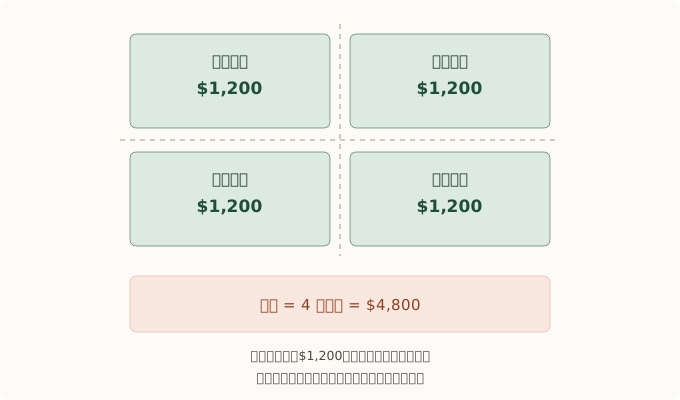
The mouth divides into four quadrants — upper left, upper right, lower left, lower right. Deep cleaning (scaling and root planing) is conventionally billed per quadrant, so a quoted "$1,200" may mean $1,200 per quadrant and $4,800 for the full mouth. The Prince Philip Dental Hospital's published private-patient schedule bills non-surgical periodontal treatment per quadrant, which illustrates the convention directly.
A related distinction: routine scaling and deep cleaning are different treatments. Routine scaling is usually one session; deep cleaning is typically staged across several visits and may need local anaesthetic. A clinic advertising "scaling $XXX" is almost certainly referring to the former. See our guide to scaling fees and periodontal treatment.
Ask: "Is that per quadrant, per session, or for the whole mouth? How many visits in total?"
Fillings: per tooth or per surface?
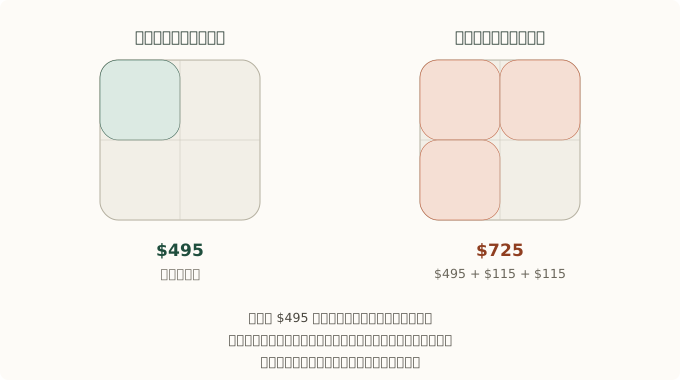
A tooth has multiple surfaces. Fillings are billed by tooth and by surface — the same tooth costs more when decay involves three surfaces than one. This is demonstrable from a published schedule: the Hong Kong Anti-Tuberculosis Association's Ruttonjee dental clinic charges $495 for the first surface and $115 for each additional surface.
So when a clinic advertises "fillings from $XXX", the "from" almost always refers to a single-surface filling.
Ask: "How many surfaces does this tooth need? What is the total?"
Root canal: per tooth or per canal?
Root canal treatment is generally quoted per tooth, but the price is driven by the number of canals: incisors usually have one, premolars one or two, molars three or four or more. A molar root canal therefore costs more than an incisor by necessity, not by mark-up.
The more common misunderstanding: the crown afterwards is usually not included in the quote. A tooth that has lost its pulp is more brittle and generally needs a crown to protect it — a separate cost. If insufficient tooth structure remains, a post and core build-up may be needed too, which is separate again.
Ask: "How many canals does this tooth have? Will it need a crown afterwards? Are the crown and any build-up charged separately?"
Implants: does that price include the crown?
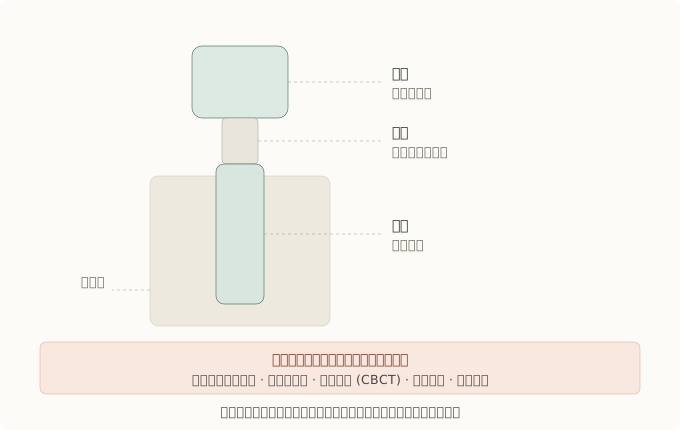
Implants are the easiest quote to misread, because a single "implant" price may cover only part of the work:
- The fixture (the implant itself)
- The abutment (the connector between fixture and crown)
- The crown (the visible tooth)
- Bone grafting or sinus lift, where bone volume is insufficient
- CBCT imaging and a surgical guide
- A provisional restoration during healing
A published schedule illustrates this unbundling plainly: the Prince Philip Dental Hospital's teaching-patient schedule lists "implant crown/bridge (per unit)" and "implant denture (per jaw)" as separate items, each explicitly noted as excluding the cost of the implant and implant components.
The most common gaps are a low headline price that excludes the crown, or bone grafting raised only after the CBCT is taken. For what can go wrong later, see our guide to loose implants and peri-implantitis.
Ask: "Does this include the abutment and the crown? If bone grafting is needed, roughly what does that add?"
Orthodontics: are retainers included?
Orthodontics is normally quoted as a whole-case fee, but these items are frequently excluded:
- Retainers — required long-term after treatment, usually charged separately
- Mid-treatment refinements
- X-rays and scans
- Extractions needed before treatment starts
- Missed-appointment and emergency-visit fees
Retainers are the most commonly overlooked item, because they are only needed once treatment ends — and they need replacing if damaged or lost. For the wider picture see our adult orthodontics guide.
Ask: "Are retainers included? Are X-rays and extractions separate? Is there a missed-appointment fee?"
Crowns: is the build-up and temporary included?
A crown quote may exclude the core build-up (the foundation, where tooth structure is insufficient), the temporary crown worn while the permanent one is made, or the impression. For how crowns fail and how to judge one, see our guide to crown failure warning signs.
Ask: "Will a build-up be needed? Is the temporary crown included?"
Full-arch reconstruction: one jaw or both?
Full-arch fixed solutions are normally quoted per arch. A "full mouth" means both arches, at roughly double the per-arch figure. Also establish whether the quote covers the provisional restoration or only the definitive one. For the sequencing of a bite rebuild, see our guide to bite collapse and rebuilding.
Ask: "Is that one jaw or both? Does it include the provisional?"
Which providers publish a fee schedule?
| Provider | Key fees | Scope | Source |
|---|---|---|---|
| Department of Health dental street service | Free for eligible persons; $850 per attendance for non-eligible persons from 1 January 2026, plus $90 per prescribed drug item | Pain relief and extraction only — no scaling, fillings or prosthetics | DH dental street service |
| Hospital Authority oral and maxillofacial surgery and dental clinics | Eligible persons $135 first attendance, $80 subsequent, $15 per drug | Referral required | HA fees and charges |
| Non-profit organisations | Routine scaling roughly $320–700; fillings roughly $300–1,000 | Roughly two dozen clinics run by the FTU, Yan Chai Hospital, Lok Sin Tong, Tung Wah, Po Leung Kuk, Caritas, St James' Settlement, Project Concern and others; fees and scope differ by organisation, so check directly | Check each organisation directly (FTU and St James' Settlement sites do not publish itemised fee schedules) |
| Prince Philip Dental Hospital | Publishes both a teaching-patient and a private-patient schedule; the difference is substantial. Teaching-patient fees are low but require the case to suit teaching needs, and waits can be long | Teaching patients and private patients | Teaching-patient schedule · Private-patient schedule |
| Private hospital dental departments | Hospitals including Hong Kong Sanatorium & Hospital publish price lists under the Pilot Scheme to Enhance Price Transparency of Private Hospitals | Dental department fees (vary by hospital) | HKSH dentistry price list |
| Community Dental Support Programme | Administrative co-payment of $50 per tooth, capped at $150 per visit | Government-subsidised programme expanded from January 2026 | Community Dental Support Programme |
By contrast, the large dental chains generally do not publish itemised fees, and typically require a phone enquiry or depend on a corporate medical card scheme. For how the different provider categories compare overall, see our comparison of Hong Kong's four dental service tiers.
What should you ask a clinic that doesn't publish fees?
Most private clinics do not publish itemised fees. That is not in itself a problem — but you are entitled to ask before treatment begins. Four questions do most of the work:
- "What is the unit for this price? Per tooth, per surface, per quadrant, per jaw, or the whole course?"
- "What does this price include? What does it exclude?"
- "What circumstances would push the actual cost above this quote?"
- "Could I have that in writing?"
The last one matters most. A verbal figure is not a quote.
What should a reliable quote contain?
A quote you can actually compare should state, at minimum: the diagnosis; the proposed treatment and the alternatives; the unit for every fee; explicit inclusions and exclusions; the cost of each stage where treatment is staged; and the circumstances that could add cost. If you are given a single total with no unit stated, you can ask for it to be itemised — or seek a second opinion.
Frequently asked questions
One clinic quoted double another. Is the higher one unreasonable?
Not necessarily. First check whether both quotes use the same unit and cover the same items — many "double" differences turn out to be one quote including the crown and the other not, or one being whole-mouth and the other per quadrant. Align the units before comparing.
What does "from $XXX" usually mean?
Usually the simplest version of the case: a single-surface filling, a single-canal root canal, an implant needing no bone graft. The more complex your case, the further the real figure sits from the "from" price.
Can I ask for a written quote?
Yes. A written quote is a reasonable request and makes comparison and review far easier. It does not commit the clinic to an unchanging final figure, but the units and inclusions should at least be set out clearly.
Can I get scaling or fillings at a government dental clinic?
No. The dental street service covers pain relief and extraction only — not scaling, fillings, prosthetics, or extractions ahead of orthodontic treatment. For those you would need a non-profit or private clinic.
Are non-profit clinics always cheapest?
For routine scaling and fillings, usually. For complex cases such as surgical wisdom tooth removal or implants, not necessarily — and some do not offer them at all. Fees also vary considerably between organisations, so check each one.
Why are Prince Philip's teaching-patient fees so low?
Because treatment is carried out by students under supervision as part of teaching. Fees are low, but the case must suit teaching requirements, treatment takes longer, and waits can be considerable. It does not suit everyone.
Can a quote change after it is given?
Yes, and in dentistry it is fairly common — decay may prove deeper than the X-ray suggested, or a root canal may become necessary. What matters is that the clinic tells you before the change and explains why.
How do I know whether a quote hides extra charges?
Asking "what does this exclude?" works better than "what does this include?" The first forces the additional items to be listed; the second is easily answered halfway.
※ The above are reference ranges compiled from public market data. Actual fees vary by clinic tier, dentist seniority, and case complexity, and do not represent any specific clinic's quote.
Related Questions
Does a cheap dental clinic always mean poor quality?
Not necessarily. A low price isn't the problem in itself; the question is whether you understand what is being saved behind that low price. If a more...
Read related articleDo I always need a follow-up after a filling?
A simple filling sets immediately, and if there is no pain, sensitivity or chipping afterwards, a dedicated review is usually unnecessary. However, if...
Read related articleCan I have follow-up locally after treatment abroad?
In principle yes, but a local dentist will handle your case as a new patient. Without the original records, they usually need to re-examine and re-ass...
Read related articleDo I need a second opinion for every dental visit?
No. Low-risk, standardised or reversible treatments such as scaling, simple fillings and routine check-ups usually do not call for one. A second opini...
Read related article