2026 Hong Kong Complete Guide to Tooth Loss in Elderly Patients: Dr. Chan Si Yan Breaks Down the Multidisciplinary Dental Treatment Process
Written and reviewed by the HK Dental Guide editorial team · Updated 21 Oct 2026 · 11 min read
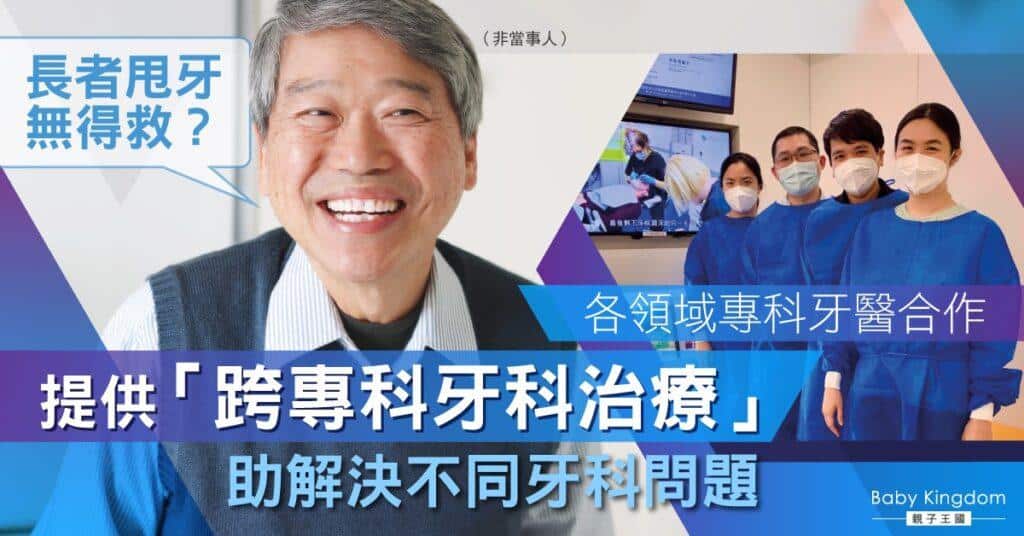
Many people mistakenly believe that dentistry is itself a specialty, but in reality, dentistry — much like general medicine — is further divided into distinct specialties based on the area of treatment. In this article, we examine a special case of tooth loss in an elderly patient submitted by a reader, and explore how multi-disciplinary dental treatment can address complex dental problems.
Mr. Yeung's Father: When Food Loses Its Joy
Mr. Yeung (pseudonym) sought consultation on behalf of his father, who had long been troubled by difficulties eating due to tooth loss. Mr. Yeung's father, now 68 years old, is a passionate food lover. Before retirement, his work took him around the world for decades, allowing him to savour countless culinary delights — a great source of joy in his life.
However, since retiring, his teeth have gradually become loose, likely due to age-related physical decline, and have been causing frequent pain. As a result, Mr. Yeung's father has been unable to chew most foods and has had to switch to bland, visually unappetising liquid meals. Initially, he would lose his temper over this, but over time, he stopped reacting with anger and instead became despondent and withdrawn, feeling that life had lost its meaning — a situation that deeply distressed his son.
Mr. Yeung shared that the whole family had encouraged his father to see a dentist as soon as possible to explore whether anything could be done. However, his father persistently refused, believing that tooth loss in old age is a natural and inevitable part of life, and that dentists would be unable to help — seeing it as a waste of both money and time. The devoted son did not give up, and a year ago brought his father to a dental emergency appointment, where a basic examination and pain relief treatment were carried out, but the underlying problem of being unable to chew remained unresolved.
Is Tooth Loss in the Elderly Beyond Treatment?
Like Mr. Yeung's father, many elderly patients face the problem of tooth loss — but does this necessarily mean nothing can be done? Dr. Chan Sze-Yan, Medical Director of the dental centre, along with her specialist colleagues — including Prosthodontics Specialist Dr. Tse Chi-Man, Periodontology Specialist Dr. Joanna Chiu, and Oral and Maxillofacial Surgery Specialist Dr. Crystal Lee — will analyse the above case from a professional medical perspective.
Periodontology Specialist Dr. Joanna Chiu, Prosthodontics Specialist Dr. Tse Chi-Man, Oral and Maxillofacial Surgery Specialist Dr. Crystal Lee, and Dental Centre Medical Director Dr. Chan Sze-Yan (from left)
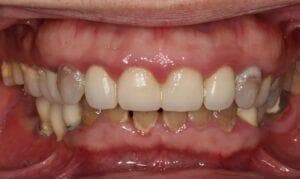
Dr. Chan Sze-Yan noted that for an up-to-date diagnosis, Mr. Yeung's father should undergo a comprehensive 360-degree full-mouth scan. Based solely on the diagnostic records provided by the reader, however, his situation is indeed complex: many of his teeth have already been lost one by one due to periodontal disease, while the remaining teeth show signs of looseness and tooth decay, with several roots having decayed to the point of being retained within the jawbone.
Mr. Yeung's father presents with multiple significant dental problems simultaneously, including periodontal disease, tooth decay, and severe jawbone resorption(external educational page). He also has a number of significant medical conditions, such as poorly controlled diabetes and the need for regular bone injection treatment (bisphosphonate therapy) due to osteoporosis — all of which make any form of dental treatment considerably more challenging.
Nevertheless, Dr. Chan emphasised that Mr. Yeung's father's case is not necessarily beyond treatment. Given the complexity of the case and the range of dental specialties involved, the patient may wish to consider a multi-disciplinary approach to dental care — that is, a comprehensive treatment plan formulated by the primary dental practitioner who is familiar with the patient's condition, with the treatment carried out collaboratively by general and specialist dentists with different areas of expertise. The primary dentist would coordinate the prosthodontist, periodontist, and oral and maxillofacial surgeon to address the various dental issues in an orderly sequence as set out in the treatment plan, and to adjust the plan as needed in response to the patient's evolving condition.
Photo provided by reader
Photo provided by reader
What Is "Multi-Disciplinary Dental Treatment"?
While "multi-disciplinary dental treatment" may not be widely known in Hong Kong, it has in recent years become an increasingly well-established treatment model in countries such as the United Kingdom and the United States, where it is referred to as "Multi-Disciplinary Dentistry".
The concept is based on the premise that dentistry encompasses a range of distinct specialties, each with its own specialist dentists who have accumulated extensive clinical experience in their respective fields. When a patient's condition spans more than one specialty, collaboration among specialists from different disciplines may offer a more effective means of addressing the root cause of the problem.
Dental specialty classifications
Learn more: How to Read a Dental Quote in Hong Kong: Billing Units, Hidden Items, and Who Publishes Fees
The Treatment Process of "Multi-Disciplinary Dental Treatment"
Dr. Chan explained that using Mr. Yeung's father's case as an example, after the primary dentist formulates an initial treatment plan, it is passed to the prosthodontist for a more detailed assessment. Based on the treatment requirements, the prosthodontist determines which teeth can be preserved to serve as future support for the dentures, and which decayed teeth need to be extracted to prevent further damage to surrounding teeth.
The periodontist then takes over to thoroughly eliminate the periodontal bacteria in the mouth and stabilise the patient's oral condition. This step is critical because if the periodontal disease and tooth decay are left unaddressed and dentures are fitted directly, the remaining teeth will not be able to provide stable support, rendering the dentures ineffective.
Furthermore, because Mr. Yeung's father has been receiving regular bone injections over an extended period, any oral wound or trauma carries a risk of complications such as osteonecrosis and tissue necrosis. For this reason, an oral and maxillofacial surgeon may need to be involved in the extraction of the decayed teeth. Finally, the prosthodontist would custom-fabricate the most suitable set of dentures for the patient.
To see how removable denture fees compare across public, subsidised, private and Shenzhen providers, see removable denture prices compared.
Example of role allocation within a "multi-disciplinary dental treatment" team
Dentures Are Not the Only Option
Prosthodontics Specialist Dr. Tse added that in addition to dentures, Mr. Yeung's father may also consider dental implants. He noted that the dentist would recommend different treatment options based on the patient's overall health and oral condition, and would determine which teeth may need to be extracted earlier so as not to compromise the durability and aesthetics of future restorations.
Based on past experience, many elderly patients are concerned about their physical condition and prefer to avoid extensive surgical procedures. In such cases, dentists generally favour more conservative approaches, such as removable dentures (dentures that can be taken in and out by the patient), rather than placing implants at multiple sites — an approach that is also more cost-effective.
Removable dentures
Where conditions permit, some teeth — though structurally fragile — may still be retained through root canal treatment(external educational page) (commonly known as root canal treatment) combined with magnetic attachments, allowing them to serve as support and anchorage for removable dentures. This significantly enhances the patient's comfort when wearing the dentures. In addition, by preserving the tooth roots, this approach helps reduce alveolar bone resorption — making future dental implant placement simpler and quicker should the patient wish to pursue that option later.
Magnetic attachment device used to secure dentures
Periodontal Disease Treatment Is Indispensable
As mentioned above, periodontal disease treatment is an essential component of the overall treatment. The patient must first have the periodontal bacteria eliminated from the mouth in order to create a healthy oral environment that is conducive to subsequent denture fabrication.
Periodontology Specialist Dr. Chiu noted that in more severe cases of periodontal disease, the dentist will generally make every effort to salvage the remaining teeth so that they can effectively support future dental prostheses. The dentist will first perform deep cleaning to remove calculus and periodontal bacteria that have accumulated on the tooth roots over many years, and will also take time to educate the patient on self-care and oral hygiene techniques. Where the patient's health permits, minor surgical procedures — such as tissue repair and bone or gum augmentation — may also be performed on loose teeth to improve their stability.
She cautioned, however, that as periodontal disease is a chronic condition, treatment cannot be completed overnight. Even after treatment, several months of follow-up appointments will be required to stabilise the condition.
As mentioned above, periodontal disease treatment is an essential component of the overall treatment. The patient must first have the periodontal bacteria eliminated from the mouth in order to create a healthy oral environment that is conducive to subsequent denture fabrication.
Periodontology Specialist Dr. Chiu noted that in more severe cases of periodontal disease, the dentist will generally make every effort to salvage the remaining teeth so that they can effectively support future dental prostheses. The dentist will first perform deep cleaning to remove calculus and periodontal bacteria that have accumulated on the tooth roots over many years, and will also take time to educate the patient on self-care and oral hygiene techniques. Where the patient's health permits, minor surgical procedures — such as tissue repair and bone or gum augmentation — may also be performed on loose teeth to improve their stability.
She cautioned, however, that as periodontal disease is a chronic condition, treatment cannot be completed overnight. Even after treatment, several months of follow-up appointments will be required to stabilise the condition.
When Is the Involvement of an Oral and Maxillofacial Surgeon Required for Extractions?
Within the multi-disciplinary dental team, the oral and maxillofacial surgeon is responsible for extracting decayed teeth. However, Oral and Maxillofacial Surgery Specialist Dr. Lee pointed out that tooth extraction is not exclusively within their domain — general dentists are also capable of performing extractions, depending on the circumstances.
She explained that Mr. Yeung's father's case is particularly complex due to his ongoing bone injection treatment, which increases the risk of difficult-to-manage complications such as osteonecrosis during tooth extraction. As a precaution, patients in similar situations often request that extractions be performed by an oral and maxillofacial surgeon, because they specialise in major, complex surgery and are equipped to handle unexpected complications.
Team members must not work in isolation
Dr. Chan stresses that the key to multi-disciplinary dental treatment is that every member of the dental team communicates closely and regularly about the patient's condition, so that each part of the treatment is completed in the order and at the time set out in the treatment plan. If a medical issue arises during treatment, the team may need to discuss whether the plan should be revised to get as close as possible to the intended result.
By contrast, if each specialist works in isolation and ignores what the others are doing, treatment may be duplicated, or the dentist responsible for the next step may find it hard to carry out the original plan.
Multi-disciplinary treatment is not for every patient
However, not every patient needs multi-disciplinary dental treatment. Dr. Chan notes that if a patient has few special medical conditions and their oral health is not too poor, involving every specialty is often unnecessary. For example, the extractions and dentures mentioned above can, where appropriate, be handled by the patient's own family dentist working together with a periodontist.
Simple cases should be handled simply, which saves both time and money. Whether to have partial or full treatment also depends on the patient's own needs and budget, and the dentist will ultimately respect the patient's wishes when drawing up the plan.
How can patients tell whether they need multi-disciplinary treatment?
Dr. Chan suggests asking a family dentist you trust whether multi-disciplinary treatment is suitable or necessary for you. In general, some local private hospitals and dental day procedure centres have a fuller range of dental specialties, with the equipment and experience to provide this kind of care.
Independent family dental clinics with plenty of collaborative experience can also work with other specialist clinics through referrals. Patients can check any dentist's qualifications at any time on the list of registered dentists published by the Dental Council of Hong Kong.
The key to success
Because the treatment involves several different procedures, and some steps need time for the mouth to heal before the next can begin, the whole process may take the better part of a year. Dr. Chan reminds patients that before starting, they need to be well prepared and committed to finishing the treatment, so they do not give up halfway. After treatment, they also need to look after their teeth and keep them clean; otherwise the chance of the problem coming back rises sharply.
After hearing the dentists' analysis, Mr. Yeung and his father feel hopeful about being able to chew and enjoy food again. After discussing it with the family, they have decided to seek a second opinion on how to deal with the dental problems troubling them.
If you have any questions, please ask a family dentist you trust.
Learn more: How to Judge Dental Implant Quality: 10 Questions to Ask First
Source: Baby Kingdom (親子王國)
Sources and further reading (public and professional bodies)
- Department of Health: Outreach Dental Care Programme for the Elderly
- Elderly Health Care Voucher Scheme: background
- Department of Health: government dental clinics (general public sessions)
- Dental Council of Hong Kong: registers of dentists and specialists
- Department of Health oral health education: dental implants
Found this useful? Pass it on
One tap to send it to family or friends on WhatsApp.
Related Questions
Is it normal for gums to bleed when brushing?
No. The DH says bleeding on brushing is a signal of gum disease, not brushing injury and not "heatiness"; herbal tea can only ease discomfort for a wh...
Read related articleWill scaling make my teeth gaps larger?
Scaling itself does not enlarge tooth gaps. The sensation of wider gaps occurs because the swollen gum tissue and tartar that had been filling the spa...
Read related articleIn Hong Kong in 2026, is it better value to buy a water flosser or dental floss?
Traditional dental floss is low in cost and highly effective at cleaning, making it the ideal everyday option for most people. Water flossers require...
Read related articleIs scaling really necessary?
Calculus cannot be brushed off; only dental instruments remove it, and its rough surface collects more plaque, which is where gum disease starts [1][4...
Read related articleCan I go to the dentist with tonsillitis?
For routine care (check-ups, scaling, fillings) it is usually better to reschedule. The NHS lists a high temperature, painful swallowing, earache and...
Read related article