Missing Teeth? 2026 In-Depth Comparison: Dental Implants vs. Dental Bridges vs. Removable Dentures — 7-Round Breakdown of Pros, Cons & Lifespan
Written and reviewed by the HK Dental Guide editorial team · Updated 21 Oct 2026 · 8 min read
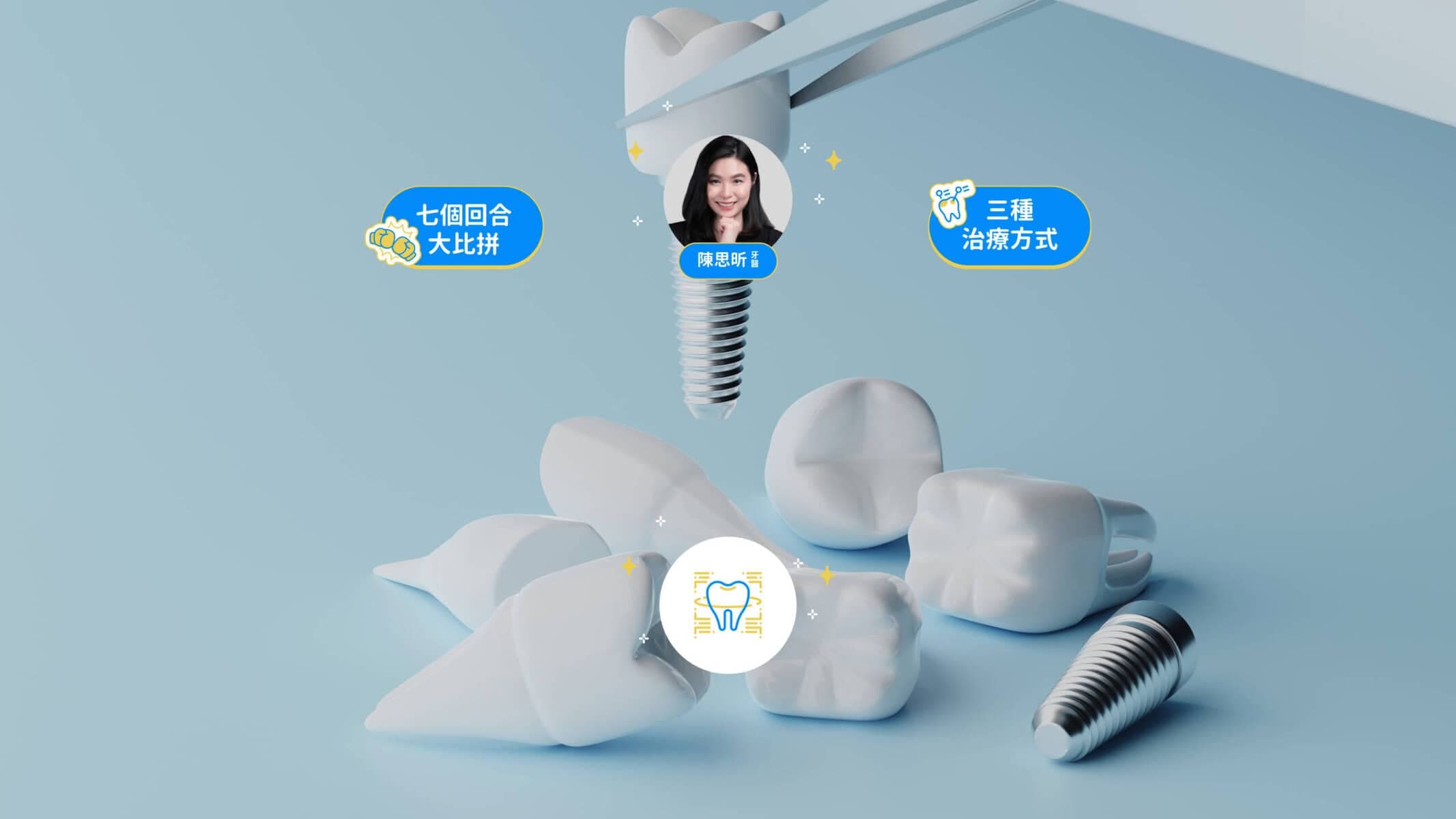
In the past, people who lost teeth would get gold or silver crowns fitted. Nowadays, those with missing teeth talk about getting a new tooth "implanted." Dental implants — though considered a modern solution for missing teeth — have in fact been available in Hong Kong for several decades. Dental implants, dental bridges, and dentures are the three most commonly used methods for replacing missing teeth today. We invited Dr. Chan Sze-Yan (陳思昕醫生), Medical Director of a dental centre, to compare the advantages and disadvantages of each approach to help you make the most informed decision.
Do you know how these three tooth replacement options work?
Dental Implant (Implant)
Involves surgery. The dentist drills into the jawbone and inserts a screw-like implant fixture (artificial tooth root). Once the wound has healed and the implant has stabilised, a porcelain crown is then attached.
Diagram: A screw-shaped implant fixture (artificial tooth root) is secured into the jawbone, after which a white porcelain crown (dental implant) is attached on top.
Dental Bridge (Fixed Prosthesis – Bridge)
No surgery required. Healthy adjacent teeth serve as abutments to support the bridge. The teeth on either side of the gap are filed down, and a set of three joined artificial teeth is cemented over them using dental adhesive. This option is only suitable when exactly one to two teeth are missing in a row.
Diagram: A three-unit set of artificial teeth (dental bridge) is placed over the adjacent teeth and secured with dental adhesive.
Dentures (Denture)
No surgery required. Removable dentures are fitted inside the mouth, with healthy natural teeth serving as supports for the prosthesis. Dentures are custom-made according to the patient's oral condition, and are held in place using metal clasps or magnets attached to natural teeth, filling in the gaps left by missing teeth. Chewing and biting forces are primarily borne by the soft gum tissue. Dentures must be removed and cleaned after each use to maintain oral hygiene. Due to their relatively lower cost, they are particularly popular among elderly patients.
Diagram: A removable denture held in place with metal clasps attached to natural teeth.
For removable denture fees side by side (public, subsidised, private and Shenzhen), see removable denture prices compared.
Learn more: How to Read a Dental Quote in Hong Kong: Billing Units, Hidden Items, and Who Publishes Fees
Dental Implants vs. Bridges vs. Dentures: A Head-to-Head Comparison
The chart below provides a concise comparison of the advantages and disadvantages of each treatment option. A detailed analysis follows.
Round 1: Treatment Duration — Dentures Are the Fastest
- Dentures: After the dentist's assessment, initial impressions are taken, and the dentures are designed and custom-fabricated. Once completed and adjusted for fit, they are ready to use. The entire process typically takes around 3 to 4 weeks, allowing patients to restore their chewing function relatively quickly.
- Dental Bridge: The process is similar to fabricating a dental crown, except that the artificial tooth is positioned between two crowns. The fabrication time is swift, and the bridge can generally be fitted within one month from the start of treatment.
- Dental Implant: After the dentist places the implant fixture into the jawbone, a healing period of 4 to 12 weeks is required for the implant to integrate with the bone before the next step can proceed. A single implant typically takes 3 to 6 months, while multiple implants may require 6 months to a year — making treatment duration the biggest drawback of dental implants. If bone grafting(external educational page), soft tissue augmentation, and surgical implant placement are required, the overall treatment course can extend to 6 months to a year, which may be a considerable burden for older patients.
Round 2: Comfort of Use — Bridges and Implants Feel Like Natural Teeth
- Dentures: Placed directly over the gum tissue, dentures tend to feel more foreign in the mouth and require a prolonged adjustment period to get used to.
- Dental Bridge: Fixed securely to the teeth like a crown, a bridge feels very similar to natural teeth during use.
- Dental Implant: By the time the porcelain crown is fitted, the implant fixture has already fully integrated with the jawbone, resulting in an overall experience that closely resembles that of a natural tooth.
Round 3: Chewing Strength — Implants Offer Stronger Bite Force
- Dentures: Biting and chewing forces are borne by the soft gum tissue, resulting in weaker chewing ability. During meals, dentures may feel loose, wobble, or even fall out.
- Dental Bridge: Biting forces are distributed across the healthy abutment teeth on either side, providing a generally acceptable level of chewing ability.
- Dental Implant: The implant fixture is anchored within the jawbone, allowing biting forces to be distributed directly into the bone — delivering the strongest chewing performance of the three options.
Round 4: Oral Health — Implants Can Compensate for Lost Tooth Roots
- Dentures: After tooth loss, the jawbone no longer receives stimulation from chewing, leading to gradual bone loss and gum recession(external educational page). Dentures have no artificial tooth root and therefore cannot provide the stimulation needed to maintain bone density. Furthermore, the pressure exerted by dentures on the underlying gum ridge may accelerate gum recession.
- Dental Bridge: Fitting a bridge requires filing down the two healthy adjacent teeth to serve as supports — a regrettable sacrifice of perfectly healthy tooth structure. Like dentures, a bridge provides no artificial tooth root, meaning the gum will inevitably recede over time.
- Dental Implant: The implant fixture (artificial tooth root) placed within the jawbone fully integrates with the surrounding bone, stimulating it just as a natural tooth root would. This reverses the bone loss and gum recession that typically follows tooth loss.
Round 5: Cleaning — Implants Are Cleaned Just Like Natural Teeth
- Dentures: Must be removed for cleaning after each use — brush thoroughly with a small amount of toothpaste, or soak in a denture-cleaning solution, then rinse with clean water. This is relatively inconvenient.
- Dental Bridge: Without the stimulation of a tooth root, the jawbone gradually loses density and the gum recedes, creating a growing gap between the bridge and the gum where food particles can easily become trapped — making the area susceptible to periodontal disease and tooth decay. Unlike natural teeth, the connected structure of a bridge means dental floss cannot be used to clean the junction between the bridge and gum; instead, small interdental brushes must be used to clean these tight spaces.
- Dental Implant: Cleaning is relatively straightforward — simply brush as you would with natural teeth. However, regular visits to the dental centre for scaling and implant check-ups are still necessary.
Diagram: Dental floss must be used correctly to clean around the implant. Gently slide the floss into the gap between the teeth, wrap it in a C-shape around one side of the implant, and move it gently up, down, and side to side to remove plaque and food debris.
Round 6: Longevity — Implants Are the Most Durable
- Dentures: Must be adjusted to match changes in oral condition. They typically need to be replaced after 5 or more years. If the mouth changes shape and the denture no longer fits snugly against the gum, a new denture will need to be made.
- Dental Bridge: The lifespan of a bridge depends on individual usage and maintenance habits — it generally lasts 10 to 15 years, and with proper care, up to 20 years. However, as the gum gradually recedes over time, the bridge and gum often no longer fit closely together after 10 to 15 years, necessitating a replacement.
- Dental Implant: Implants generally have a longer service life. With proper care, they can last more than 20 years, depending on the patient's usage and oral hygiene habits — making implants a longer-term, higher-quality treatment option.
Round 7: Aesthetics — Implants Most Closely Resemble Natural Teeth
- Dentures: Must be removed for cleaning after meals and before bed, so they cannot always maintain a presentable appearance. The metal clasps may sometimes be visible, which can look unsightly. In some cases, if the wearer laughs too broadly, the denture may slip out.
- Dental Bridge: Bridges are typically made from full zirconia crowns, which are harder than natural teeth, highly wear-resistant, and aesthetically pleasing. However, the colour tends to appear somewhat flat and opaque compared to natural teeth.
- Dental Implant: Implants are typically fitted with full porcelain crowns, which closely replicate the translucency, texture, and natural warmth of real teeth — making them virtually indistinguishable from natural teeth. Their hardness is comparable to tooth enamel, and they are unlikely to be damaged under normal use, making them the most realistic-looking option of the three.
Before and after dental implant treatment
Overall — there is no single right answer; it depends on your needs and budget
Overall, removable dentures are the most affordable option and need no surgery. Even people who have lost all their teeth can eat with full removable dentures, although dentures are also the least convenient to live with.
Dental bridges are moderately priced and also need no surgery, with results that sit in the middle of the three.
Dental implants do not affect the neighbouring teeth and are better for long-term oral health, but they need surgery, your general health has to be assessed first, treatment takes a long time and the cost is high, so not everyone can commit the time and money.
Each way of replacing missing teeth has its merits. Your dentist can give professional advice and talk it through with you so you can make a well-informed choice. If in doubt, please ask a family dentist you trust.
Learn more: How to Judge Dental Implant Quality: 10 Questions to Ask First
Sources and further reading (public and professional bodies)
- Department of Health oral health education: dental implants
- Dental Council of Hong Kong: registers of dentists and specialists
- Consumer Council: dental service complaints and tips (2024)
- Cambridge University Hospitals (NHS): Dental implants in restorative dentistry
- Department of Health: government dental clinics (general public sessions)
Found this useful? Pass it on
One tap to send it to family or friends on WhatsApp.
Related Questions
How much does a dental implant cost in Hong Kong in 2026?
Clinic fixtures HK$17,000–18,000 plus about HK$6,000 for the crown; HKU resident-dentist clinic from HK$23,000; private hospitals HK$40,000–45,000 [6]...
Read related articleWill removable dentures become loose over time?
Yes. As we age, the jawbone gradually resorbs, causing the denture to no longer fit snugly. Dr. Wong Man-cheong recommends attending regular follow-up...
Read related articleCan I eat immediately after dental implant surgery? Will it be painful?
It is advisable to wait until the anaesthesia has worn off before eating, and to consume soft foods only. Minimally invasive surgery generally causes...
Read related articleHow much do dentures cost in Hong Kong in 2026?
Per arch: teaching patients $430–760 [6], CDSP co-payment $500–1,000 [3], private clinics $4,000–8,000 [8], private hospitals $8,000–50,000 [10][11].
Read related articleAre there risks associated with Monitored Anesthesia Care?
All forms of sedation involving medications carry inherent risks. Potential risks include respiratory depression, a drop in blood pressure, and allerg...
Read related article