2026 Hong Kong Denture Types Compared: Complete Guide to Pros, Cons & Prices of Dental Bridges, Implants & Removable Dentures
Written and reviewed by the HK Dental Guide editorial team · Figures checked 21 Oct 2026 · 9 min read
On this page(5)
Short answer: There are three main ways to replace missing teeth: a bridge (the teeth on either side are trimmed to support it), an implant (an artificial root placed in the jawbone by surgery) and a removable denture (taken in and out, no surgery), and a dentist chooses between them after checking how many teeth are missing and the state of the bone and gums. Published fee examples: the HKU Faculty of Dentistry resident-dentist clinic lists a removable denture at HK$6,000 per arch and implant surgery at HK$23,000 (HKU resident-dentist fee schedule, effective 3 Sep 2025); under the Community Dental Support Programme, eligible people with fewer than 20 remaining teeth and difficulty eating or chewing can get removable dentures for a co-payment of $500 (Category A) or $1,000 (Category B) per denture, at most twice and at least 5 years apart (Community Dental Support Programme). Checked 30 September 2026.
Fee benchmark: the sourced denture fee table is at Hong Kong denture prices 2026; this article compares bridges, implants and removable dentures.
Part Two: Article Body
Once a permanent tooth is congenitally missing or extracted due to severe dental disease, it is gone for good. Since different teeth — such as incisors, canines, and molars — each serve distinct functions, tooth loss directly affects chewing ability, speech, and appearance. In Hong Kong in 2026, dental restoration technology is highly advanced. Dr. Wong Man-cheong of the Department of Dentistry at Hong Kong Sanatorium & Hospital notes that dentures are broadly categorised as "fixed" or "removable," and that a comprehensive clinical assessment must be carried out before making a choice, in order to weigh the risks and likelihood of success.
1. Fixed Prostheses: High Stability with Minimal Foreign Body Sensation

Fixed prostheses are primarily divided into dental bridges and dental implants, and are commonly made from full metal, full ceramic, or porcelain-fused-to-metal materials.
-
Dental Bridge:
-
How it works: The teeth adjacent to the gap are used as "abutments" — they are filed down and crowned to anchor a connected prosthetic tooth in between.
-
Advantages: High stability, closely resembles natural teeth in size, and requires a short adaptation period.
-
Risks: Requires grinding down healthy adjacent teeth, which may cause sensitivity or pain, and may even necessitate root canal treatment.
-
-
Dental Implant:
-
How it works: A titanium implant fixture is surgically placed into the jawbone, and a crown is fitted once the site has healed.
-
Advantages: No need to alter adjacent teeth, delivers the strongest biting force, and causes minimal foreign body sensation.
-
Risks: Requires surgery; if bone volume is insufficient, bone grafting or sinus lift surgery may be needed beforehand.
-
2. Removable Dentures: An Economical Solution for Multiple Missing Teeth
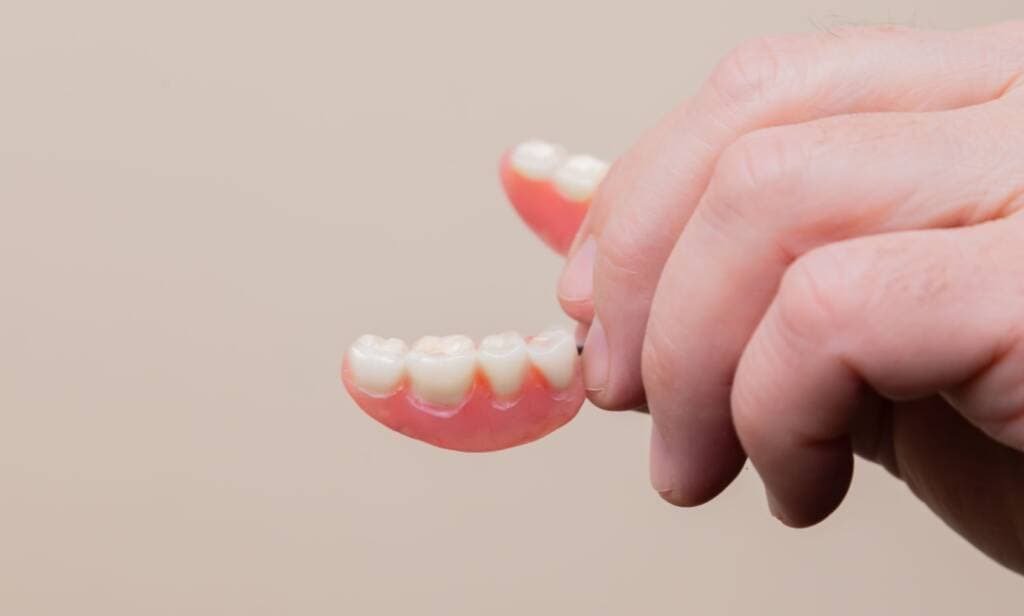
Removable dentures, commonly referred to as denture plates, consist of prosthetic teeth mounted on a base plate that patients can put in and take out at will.
-
Advantages: Can restore multiple or even a full arch of missing teeth in one go, requires no surgery or tooth grinding, and is suitable for patients who are not candidates for dental implants.
-
Disadvantages: Larger in size, causing a more noticeable foreign body sensation; may initially affect speech; and sticky foods should be avoided.
3. 2026 Hong Kong Denture Fee Reference Table
Denture fees vary depending on the materials used, the number of missing teeth, and the complexity of the procedure.
| Denture Type | Reference Fee (HKD) | Notes |
| Dental Bridge (from 3 units) | HK$12,000 – HK$24,000 | Depends on materials and dentist's experience |
| Single Dental Implant (including crown) | HK$15,000 – HK$35,000 | Budget for possible bone grafting surgery |
| Partial Removable Denture | HK$4,000 – HK$12,000 | Suitable for multiple missing teeth |
| Full Removable Denture | HK$15,000 – HK$30,000 | Depends on denture material (e.g. acrylic or metal framework) |
How to read this table: the ranges above are general reference ranges without a single published source; the written quote from the clinic is what counts. Published fee examples: the HKU Faculty of Dentistry resident-dentist clinic lists a removable denture from HK$6,000 per arch, a crown or bridge unit from HK$6,000 and implant surgery from HK$23,000, with laboratory fees extra (HKU resident-dentist fee schedule); under the Community Dental Support Programme eligible people pay $500 (Category A) or $1,000 (Category B) per removable denture, with the upper and lower jaw counted as one denture each (Community Dental Support Programme). Checked 21 October 2026.
4. Dr. Wong Man-cheong: Dentures Also Require Regular Maintenance
Dr. Wong emphasises that although dentures cannot develop tooth decay, neglecting their cleanliness can still lead to serious consequences:
-
Cleaning a dental bridge: Regular dental floss cannot reach the underside of a bridge. It is recommended to use super floss or a water flosser to prevent the abutment teeth from developing tooth decay or periodontal disease.
-
Implant care: Similar to natural teeth, but regular X-ray examinations are required to guard against peri-implantitis.
-
Cleaning removable dentures: Use a soft-bristled toothbrush or soak in a denture-cleaning solution. Dr. Wong advises cleaning over a basin filled with water to prevent the denture from breaking if dropped.
5. Types of Removable Dentures: Full, Partial, Acrylic, Metal-Framework and Non-Metal-Clasp
Short answer: A removable denture is a set of false teeth you can take in and out yourself. By coverage there are two kinds: complete (full) dentures, for when all the teeth in the upper or lower jaw are missing, and partial dentures, which replace one or more missing teeth when some natural teeth remain1,2. By material, partial dentures can be plastic, metal or a combination of both; complete dentures are generally made of plastic2.
| Type | How it stays in | Advantages | Points to note |
|---|---|---|---|
| Complete denture | Suction between the denture and the gums and jawbone3 | No surgery and no trimming of teeth; replaces a whole arch at once3 | Gums and jawbone shrink with age, so the denture loosens and needs relining or remaking by a dentist1,2 |
| Partial denture (acrylic, or with a metal framework) | Usually small metal clasps that rest on or grip the remaining natural teeth2,3 | Replaces several teeth at once; the Consumer Council notes it costs less than bridges or implants3 | Bulkier and harder to get used to at first; food collects around the clasps, so the Consumer Council advises taking it out to rinse after eating3; the remaining teeth and gums must be healthy to support it2 |
| Non-metal-clasp denture (often marketed as "flexible" or "invisible") | Clasps made of thermoplastic resin instead of metal hooks4 | No visible metal clasps4 | A 2014 clinical-application paper in the Journal of Prosthodontic Research (the Japan Prosthodontic Society's journal) defines it as a separate category with specific indications; it does not suit everyone and needs a dentist's assessment4 |
How to choose: the number of missing teeth, the health of the remaining teeth and gums, budget and appearance all affect which type fits; for the comparison with bridges and implants see sections 1 and 2 above. New dentures usually take a few weeks to get used to; softer food cut into small pieces helps at first1,2. Public, subsidised and private fee benchmarks are in the 2026 Hong Kong fee benchmark, which also covers daily cleaning. Checked 9 October 2026.
Part Three: Frequently Asked Questions (FAQ)
-
Q1: Will removable dentures become loose over time?
-
A: Yes. As we age, the jawbone gradually resorbs, causing the denture to no longer fit snugly. Dr. Wong Man-cheong recommends attending regular follow-up appointments for adjustments. If the looseness is significant, the denture may need to be remade or implant-retained dentures considered.
-
-
Q2: Is everyone suitable for dental implants?
-
A: No. Long-term smokers, patients with severe diabetes, or those taking bisphosphonates (medications for osteoporosis) face a higher risk of implant failure and must undergo a thorough assessment by a dentist.
-
-
Q3: Can Hong Kong's Elderly Health Care Vouchers be used for dentures in 2026?
-
A: Yes, at dentists enrolled in the Elderly Health Care Voucher Scheme; clinics that have not enrolled cannot accept vouchers. Eligible people aged 65 or over receive $2,000 a year, up to an accumulated $8,000, and vouchers cannot be used for prepaid services (Elderly Health Care Voucher Scheme: types of service providers, restrictions). Check the list of enrolled healthcare service providers before booking. Eligible people can also get removable dentures under the Community Dental Support Programme (see the short answer at the top). Checked 7 October 2026.
-
Removable denture FAQ
-
Q4: How much does a removable denture cost in Hong Kong?
-
A: It depends on whether it is full or partial, the material and where it is made. Published fee examples: the HKU Faculty of Dentistry resident-dentist clinic lists a removable denture at HK$6,000 per arch5; under the Community Dental Support Programme eligible people pay $500 (Category A) or $1,000 (Category B) per denture6. Private fees vary widely, so ask for an itemised written quote first; see how to read a dental quote. Checked 9 October 2026.
-
-
Q5: Where can I get a removable denture made in Hong Kong?
-
A: There are three main routes: (1) a private dentist; (2) university dental services such as the HKU Faculty of Dentistry clinic, at published fees5; (3) for eligible people, the Community Dental Support Programme6, or Elderly Health Care Vouchers at an enrolled dentist (see Q3). Note that Department of Health emergency dental sessions only provide pain relief and extractions, not dentures7. Before choosing a dentist you can verify their registration.
-
-
Q6: How long does it take to get used to a new denture? Can I sleep in it?
-
A: The NHS says it can take a few weeks to get used to dentures, and speech may sound slightly different at first1,2. The NHS advises taking them out every night and storing them in water or an overnight cleaning solution unless your dentist says otherwise; the Consumer Council likewise advises not wearing them to sleep so the gums can rest1,3. Clean them with a soft brush and soap over a sink of water so they do not break if dropped, and do not use toothpaste1. If a denture becomes loose, hurts the gums or cracks, see a dentist to have it adjusted1,3.
-
Sources for the denture types and FAQ
- NHS — Dentures (false teeth): nhs.uk (checked 9 Oct 2026)
- Better Health Channel (Victoria State Government, Australia) — Dentures: betterhealth.vic.gov.au (checked 9 Oct 2026)
- Consumer Council, CHOICE issue 537 (July 2021), elderly dental problems (Chinese): consumer.org.hk (checked 9 Oct 2026)
- Fueki K, et al. Clinical application of removable partial dentures using thermoplastic resin — Part I: Definition and indication of non-metal clasp dentures. J Prosthodont Res 2014;58(1):3–10: doi.org
- HKU Faculty of Dentistry resident-dentist fee schedule (effective 3 Sep 2025): iad.facdent.hku.hk
- Community Dental Support Programme: communitydental.gov.hk
- Department of Health — General public sessions (emergency dental service): dh.gov.hk
※ Actual fees depend on case difficulty.
Found this useful? Pass it on
One tap to send it to family or friends on WhatsApp.
Related Questions
How much does a dental implant cost in Hong Kong in 2026?
Clinic fixtures HK$17,000–18,000 plus about HK$6,000 for the crown; HKU resident-dentist clinic from HK$23,000; private hospitals HK$40,000–45,000 [6]...
Read related articleCan I eat immediately after dental implant surgery? Will it be painful?
It is advisable to wait until the anaesthesia has worn off before eating, and to consume soft foods only. Minimally invasive surgery generally causes...
Read related articleHow much do dentures cost in Hong Kong in 2026?
Per arch: teaching patients $430–760 [6], CDSP co-payment $500–1,000 [3], private clinics $4,000–8,000 [8], private hospitals $8,000–50,000 [10][11].
Read related articleAre there risks associated with Monitored Anesthesia Care?
All forms of sedation involving medications carry inherent risks. Potential risks include respiratory depression, a drop in blood pressure, and allerg...
Read related articleIs full mouth rehabilitation the same as implants on every tooth?
No. It is a treatment concept, and the tools may include any combination of crowns, veneers, bridges, dentures and implants. Natural teeth that can be...
Read related article