2026 Hong Kong Dental Filling Cost Guide | About HK$600–1,500 at Clinics, with Public, Subsidised and Hospital Benchmarks
Written and reviewed by the HK Dental Guide editorial team · Figures checked 25 Sep 2026 · 13 min read
On this page(11)
How much does a filling cost in Hong Kong in 2026? A composite filling is typically HK$600–1,500 per tooth at private clinics and HK$2,500–15,000 at private hospitals; under the Community Dental Support Programme it is free (Class A) or $50 per tooth (Class B), and primary pupils are covered by the School Dental Care Service. Verified 25 September 2026.
Filling prices run from free to five figures; the gap comes down to who does it, where, which material and how deep the decay goes. This page lines up published public, subsidised, private clinic, private hospital and Shenzhen fees, each with a source and verification date. The site-wide fee overview uses the same data.

2026 Hong Kong Dental Filling Fee Benchmark
All figures are per tooth. Clinic price lists usually itemise by front/back tooth rather than material; hospital schedules itemise by specialty. The Shenzhen column reproduces prices compiled by Hong Kong media and is not a recommendation.
| Item | Public (DH / HA / university dental) | Non-profit / subsidised | Private clinic (typical range) | Shenzhen (published) |
|---|---|---|---|---|
| Composite filling (per tooth) | DH emergency sessions cover pain relief and extraction only, not fillings1; School Dental Care Service (P1–P6) annual fee $45 eligible / $970 non-eligible, fillings included2,3 | Community Dental Support Programme: Class A free, Class B $50 per tooth, up to 3 teeth per 180 days4 | $600–1,5007,8; private hospitals $2,500–15,0009,10 | ¥140–99911 |
| Amalgam (silver) filling | Public and subsidised fees do not vary by material; the dentist decides on clinical grounds4 | As above: Class A free, Class B $50 per tooth4 | Most price lists do not itemise by material; generally within $600–1,5007,8; hospital schedules list composite only9,10 | Not itemised publicly |
| Inlay / crown (large cavity) | Prince Philip Dental Hospital teaching patients: inlay/onlay/crown $870 per tooth6 | CDSP does not cover crowns (bridge/crown removal added from 2026)5 | Crown $4,500–8,5007,8; private hospital inlay/crown $18,000–25,0009,10 | No verifiable published price for a stand-alone crown (the /fees hub's ¥1,880–6,980 is, in source11, an implant-plus-porcelain-crown package price, not a crown alone) |
| Children's primary-tooth filling | School Dental Care Service: annual fee covers scaling, fillings and extractions2,3 | Adolescent Oral Health Co-care Pilot (age 13–17) covers check-up, scaling and fluoride only, not fillings15 | Rarely itemised on clinic price lists7,8; private hospital paediatric fillings $1,200–6,0009,10 | Not itemised publicly |
What the price includes and what it does not
A filling quote normally covers only the filling itself. The following items are usually charged separately on published price lists:
- Consultation: private clinics $100–3007,8; private hospital specialist consultation $1,500–2,5009,10; PPDH teaching patients $506.
- X-rays: intra-oral $100 and full-mouth $300–400 at clinics7,8; hospital periapical/bite-wing $200–300 and panoramic $650–1,0009,10. They check the depth of decay and hidden decay between teeth; not every tooth needs one.
- Local anaesthetic: usually included in the filling fee, but worth asking.
- Material and position: front teeth can cost more than back teeth at the same clinic, for example $600–1,200 for back teeth and $600–1,500 for front teeth on one price list, depending on the branch7.
- Follow-up / bite adjustment: a "high spot" may need trimming afterwards; most clinics do not charge, but confirm.
- Laboratory fees for inlays or crowns: a separate item if a large cavity needs one; the laboratory fee is usually built into the quote, but check.
The Consumer Council notes that consultation, X-ray and medication fees "may be charged as separate items" and advises confirming with the dentist exactly what the treatment fee covers17.
Why do prices vary so much?
- Who does it: the Dental Council's Specialist Register has eight specialties, including prosthodontics and paediatric dentistry16. Specialist fees are generally higher than general practice, as hospital filling fees itemised by specialty show9,10.
- Depth of decay and number of surfaces: a simple occlusal cavity is quick; one involving the contact surface between teeth needs a matrix band and wedge to rebuild the contour and contact point, demanding more skill and consumables. Once decay reaches the pulp, root canal treatment is needed instead21.
- Clinic or hospital: the same composite filling is $600–1,500 at clinics7,8 and $2,500–15,000 at private hospitals9,10; the difference is mainly premises, specialist consultation and equipment.
- Material and laboratory work: amalgam is generally cheaper than tooth-coloured materials24; inlays and crowns are made in a dental laboratory, which moves the price into a different bracket6,9,10.
- Number of visits: a direct filling is done in one visit; an inlay or crown usually takes two (impression and fitting), and each visit may carry a consultation fee.
Using public and subsidised services
- DH emergency dental sessions: pain relief and extraction only; the DH states explicitly that fillings, scaling and dentures are not included1.
- School Dental Care Service (P1–P6): annual fee $45 for eligible persons, $970 for non-eligible2; services include scaling, fillings, extractions and oral health education3; enrol through the school.
- Community Dental Support Programme (CDSP): eligible persons (for example Old Age Living Allowance recipients, HA medical fee waiver holders and homeless persons) attend participating non-profit clinics; fillings are free for Class A and $50 per tooth for Class B, up to three teeth per 180 days4. From 1 January 2026 it was extended to more homeless persons and added scaling and root canal treatment5. Contact a participating clinic or apply through a registered social worker4.
- Elderly Health Care Vouchers (age 65+): $2,000 a year with an accumulation cap of $8,00012, usable at enrolled dentists13, so vouchers can pay for a filling.
- PPDH teaching patients: consultation $50, inlay/crown $870 per tooth6; the schedule does not itemise fillings, treatment is by students and waiting times are longer.
Eligibility and application steps for each scheme are in the dental subsidy overview.
Getting a filling in Hong Kong: public, subsidised or private
There are three broad routes. Public: DH emergency dental sessions do not provide fillings1, but primary school pupils (P1–P6) can have fillings through the School Dental Care Service2,3. Subsidised: eligible persons can have fillings at participating non-profit clinics under the CDSP, free for Class A and $50 per tooth for Class B4, and people aged 65 or over can pay with Elderly Health Care Vouchers12,13. Private: a composite filling costs about $600–1,500 per tooth at clinics7,8 and $2,500–15,000 at private hospitals9,10. Whichever route you take, ask what the quote covers and who will treat you, and check the dentist on the Dental Council register16.
Five questions to ask before you accept a quote
- Is the price per tooth or per surface? Does it include the check-up and X-rays?
- Which material (composite, amalgam, glass ionomer)? Is there a different price for front and back teeth?
- Which dentist will do it, general practitioner or specialist? You can check the Dental Council register.
- If the cavity turns out to be deeper and needs root canal treatment or a crown, how does the price change, and will the dentist stop and re-quote first?
- If the tooth is sensitive or the bite feels wrong afterwards, is the adjustment visit charged?
Once you have a written quote, run it against how to read a dental quote item by item.
Shenzhen vs Hong Kong: more than the price
Published Shenzhen filling prices of about ¥140–99911 are clearly lower than Hong Kong clinic prices of $600–1,5007,8. The Consumer Council points out, however, that the mainland has no independent statutory body regulating dentists or dental clinics, and complaints go through the local health department17. A filling is a single-visit, lower-risk procedure, but if it turns sensitive, falls out or develops secondary decay, the return trips are part of the cost. Elderly Health Care Vouchers can be used at the Shenzhen dental institutions listed on the voucher scheme website14. For larger cross-border treatment, see Hong Kong vs Shenzhen implant costs.
What a filling is and how to choose the material
The WHO reports that untreated caries in permanent teeth is the most common health condition worldwide26. Decay starts in the enamel and spreads into the dentine, forming a visible cavity27. The DH advises that early decay confined to enamel can be arrested with high-concentration fluoride, but once it reaches the dentine the tooth must be restored; daily oral care alone will not stop it19.
Three common filling materials
- Amalgam (silver filling): a mixture of mercury, silver, tin and copper22. The DH describes it as strong and wear-resistant, able to withstand heavy biting forces, so it suits back teeth; the drawback is its silver-grey colour18. The ADA notes it is generally more affordable than tooth-coloured materials24. EU regulation bars amalgam for primary teeth, children under 15 and pregnant or breastfeeding women unless the dentist deems it strictly necessary, and the UK has agreed to phase it down23. Some clinicians also argue that its long-term thermal expansion and contraction can crack the tooth. When an old amalgam filling is removed, dentists generally use a rubber dam and high-volume suction to limit mercury vapour.
- Composite resin: close to natural tooth colour, suited to front teeth and cosmetic repairs, slightly weaker than amalgam18; good durability in small-to-mid-size fillings24. Composite bonds chemically and is usually placed and light-cured in layers to reduce shrinkage stress. A 2014 Cochrane review found low-quality evidence that composite fillings in back teeth fail more often and carry a higher risk of secondary caries than amalgam25, so discuss the choice for large back-tooth cavities.
- Glass ionomer cement: releases fluoride, which helps prevent decay at the junction between filling and tooth, but it is weaker and wears faster, so it is mostly used on non-chewing surfaces and primary teeth18.
For a material-by-material comparison see the amalgam vs composite guide and filling material price comparison.
The filling procedure
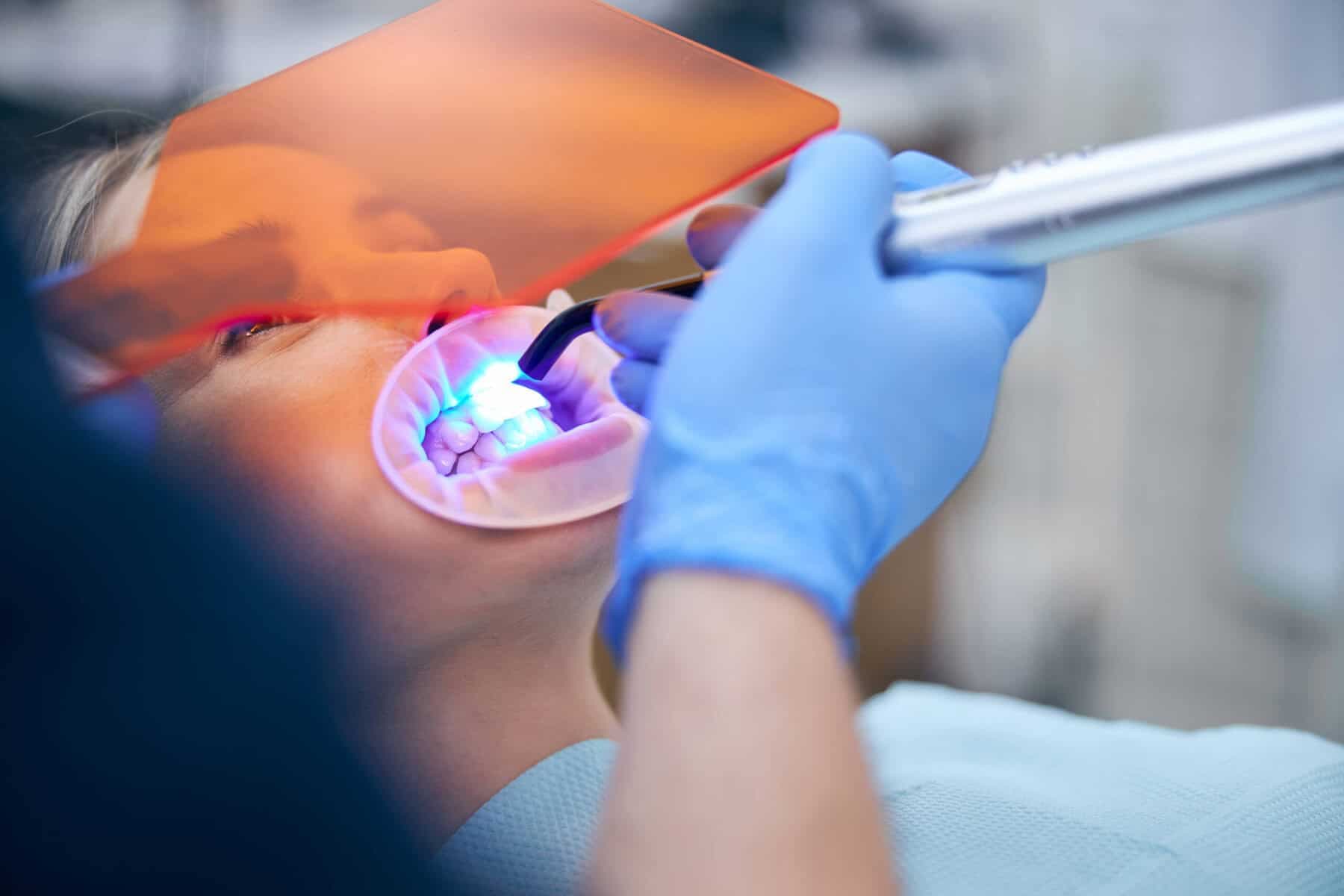
The DH lists the standard steps: remove decayed tissue, acid-etch (composite or glass ionomer), apply bonding agent, place the material, light-cure, then trim and polish18. For a contact-surface cavity a matrix band and wedge go in first, and the finished filling should let floss pass smoothly.
Micro-leakage: the main reason fillings fail
A composite filling is a chemical bonding process. With inadequate moisture control, microscopic gaps (micro-leakage) form between filling and tooth, and bacteria enter along them, leading to:
- Secondary caries: decay continuing under an apparently intact filling, the type of failure the Cochrane review measures25.
- Pulp inflammation: bacteria travel through the dentinal tubules and cause irreversible pulpitis, which ends in root canal treatment21.
- Structural breakdown: bond failure lets the filling fall out, or the tooth fractures under load.

That is why isolation matters. A rubber dam is a thin sheet that isolates the tooth from the rest of the mouth so the working area stays dry and free of saliva; it adds time and cost, but it is the reliable way to bond composite. A dentist may also use caries indicator dye to remove only what is decayed, and take care over the marginal seal and contour so food does not pack between teeth.
When a filling is no longer enough
- Decay into the pulp: once the pulp is inflamed or dead, root canal treatment is needed to clear bacteria from the pulp chamber21. Private clinics charge $4,000–8,000 per tooth7,8 and private hospitals $12,000–25,0009,10; see root canal cost.
- Too little tooth left: the DH notes that a tooth that has had root canal treatment and carries a large filling is fragile and should be crowned to prevent fracture20,21; a large cavity with a healthy pulp may instead suit an inlay or onlay rather than a direct filling. Crowns are $4,500–8,500 at clinics7,8 and $18,000–25,000 at hospitals9,10.
- Tooth fractured beyond saving: extraction, followed by an implant, bridge or denture; a single implant at a private clinic starts at $17,000–18,0007,8.
In other words, a $600–1,500 early filling left until it needs root canal treatment plus a crown can cost $8,500–16,500 at a private clinic, and extraction plus an implant runs to tens of thousands. Each stage is set out in tooth decay stages and treatment costs.
Sensitivity and aftercare
The DH says a tooth may be more sensitive after a filling and feel sore or weak, and that this discomfort "reduces with time"19. If it goes on for several weeks without improving, if biting causes a sharp pain, or if there is throbbing pain, the bite may have a high spot or the decay may have reached the pulp, so go back for a check. Keep brushing and flossing as normal and attend regular check-ups, because the margin of a filling is where decay most often recurs.
Why do some fillings fall out early?
Three common causes: bond failure (poor moisture control during placement), overload (night-time grinding), or a cavity too large for a direct filling that should have had an inlay or crown. If a filling keeps falling out, ask the dentist why and what alternative restoration is suitable.
When to see a dentist straight away
- Severe pain after a filling, pain that wakes you at night, or pain that painkillers do not touch.
- Swelling of the face or gum, pus, or fever.
- A lost filling that leaves a sharp edge cutting the tongue or cheek, or an exposed cavity that is very sensitive.
- A cracked tooth or a sharp pain on biting.
- Sensitivity after a filling that lasts several weeks and is getting worse.
Out of hours, the DH's 11 emergency dental clinics handle pain relief and extraction1; see the toothache emergency guide.
Frequently asked questions
How much is a filling in Hong Kong in 2026?
About $600–1,500 per tooth at private clinics7,8 and $2,500–15,000 at private hospitals9,10; CDSP fillings are free for Class A and $50 per tooth for Class B4.
What does a filling fee cover, and why do quotes differ so much?
A filling quote usually covers just the filling itself, and local anaesthetic is normally included; consultation ($100–300 at private clinics) and X-rays ($100–400) are usually charged separately7,8. The Consumer Council notes that consultation, X-ray and medication fees "may be charged as separate items", so ask what the fee covers17. Quotes differ mainly because of: general dentist or specialist16; the depth of decay and number of surfaces; clinic or hospital (a composite filling costs $600–1,500 per tooth at clinics and $2,500–15,000 at private hospitals)7–10; material and laboratory work24; and the number of visits. See "What the price includes and what it does not" and "Why do prices vary so much?" above.
Does the filling fee include the check-up and X-rays?
Usually not: price lists show consultation $100–300 and X-rays $100–400 separately7,8. Ask whether the quote is per tooth or per surface.
Why is a filling so much cheaper at some clinics?
GP or specialist, depth of decay, clinic or hospital, material and number of visits. Cheap is not necessarily worse, nor expensive better; ask what the quote covers and who will treat you.
Can I get a filling at a government dental clinic?
DH emergency sessions handle pain relief and extraction only and explicitly exclude fillings1. Primary pupils can use the School Dental Care Service2,3; eligible adults can use the CDSP4.
How do I choose a dentist for a filling?
Check the registration on the Dental Council register first, then ask about the quote, material and follow-up. The Specialist Register lists eight specialties16; see how to verify a dentist.
How long should sensitivity last after a filling?
The DH says post-filling sensitivity reduces with time19. If it persists for several weeks or worsens, return to have the bite and the pulp checked.
Related guides
- Hong Kong dental fee overview: public, private and Shenzhen benchmarks for scaling, fillings, root canals, implants and more.
- Dental subsidy overview: eligibility and application steps for the School Dental Care Service, CDSP and health care vouchers.
- Filling material price comparison: composite, amalgam, glass ionomer and inlays side by side.
- Amalgam vs composite guide: durability, appearance and safety of the two materials.
- Tooth decay stages and treatment costs: from early decay to root canal and extraction.
- Root canal cost: the fee benchmark when decay reaches the pulp.
- How to read a dental quote: checking what a quote covers, item by item.
- How to verify a dentist: using the Dental Council's general and specialist registers.
Sources
- Department of Health: Emergency dental services for the public. dh.gov.hk (page revised 30 Jul 2026; verified 25 Sep 2026)
- Department of Health: School Dental Care Service fees. dh.gov.hk (revised 1 Sep 2026; verified 25 Sep 2026)
- DH Oral Health Education Unit: FAQ on the School Dental Care Service and government dental clinics. toothclub.gov.hk (verified 25 Sep 2026)
- Community Dental Support Programme: introduction, services and co-payment. communitydental.gov.hk (verified 25 Sep 2026)
- Government press release: CDSP extended from 1 January 2026. info.gov.hk (17 Dec 2025; verified 25 Sep 2026)
- Prince Philip Dental Hospital: Schedule of fees for teaching patients. ppdh.org.hk (effective 1 Mar 2026; verified 25 Sep 2026)
- Private clinic market reference: Bowtie (insurer): tooth decay guide with clinic fee reference (Chinese) (24 Apr 2026; standard filling $600–1,800+); this site also checked two private clinics' published price lists in Sep 2026 (not named or linked, to stay neutral). checked 5 Oct 2026.
- Private clinic market reference: Bowtie (insurer): 2026 Hong Kong dentist fee comparison (Chinese) (updated 24 Jul 2026; fillings $500–1,200 per tooth); this site also checked two private clinics' published price lists in Sep 2026 (not named or linked, to stay neutral). checked 5 Oct 2026.
- Union Hospital: Dental charges. union.org (effective 1 May 2026; verified 25 Sep 2026)
- Hong Kong Sanatorium & Hospital: Dental Centre charges. hksh.com (effective 1 Aug 2026; verified 25 Sep 2026)
- Economic Digest: Mainland dental fees. edigest.hk (21 Sep 2026; verified 25 Sep 2026)
- Elderly Health Care Voucher Scheme: Background (amount and accumulation cap). hcv.gov.hk (verified 25 Sep 2026)
- Elderly Health Care Voucher Scheme: Types of healthcare service providers (including dentists). hcv.gov.hk (verified 25 Sep 2026)
- Elderly Health Care Voucher Greater Bay Area Pilot Scheme: FAQ (dental institutions covered). hcv.gov.hk (Sep 2026; verified 25 Sep 2026)
- Adolescent Oral Health Co-care Pilot Programme: introduction. communitydental.gov.hk (verified 25 Sep 2026)
- Dental Council of Hong Kong: Lists of registered dentists and Specialist Register. dchk.org.hk (verified 25 Sep 2026)
- Consumer Council: Complaint record no. 572, dental services. consumer.org.hk (Jun 2024; verified 25 Sep 2026)
- DH Oral Health Education Unit: Treatment room, fillings (materials and steps). toothclub.gov.hk (verified 25 Sep 2026)
- DH Oral Health Education Unit: FAQ on tooth decay and post-filling discomfort. toothclub.gov.hk (verified 25 Sep 2026)
- DH Oral Health Education Unit: Treatment room, crowns. toothclub.gov.hk (verified 25 Sep 2026)
- DH Oral Health Education Unit: Treatment room, root canal treatment. toothclub.gov.hk (verified 25 Sep 2026)
- NHS: What are NHS fillings and crowns made of? nhs.uk (verified 25 Sep 2026)
- NHS Business Services Authority: Can I provide an amalgam filling? (citing Regulation (EU) 2017/852, Article 10(2)). nhsbsa.nhs.uk (verified 25 Sep 2026)
- American Dental Association, MouthHealthy: Dental filling options. mouthhealthy.org (verified 25 Sep 2026)
- Rasines Alcaraz MG et al., Cochrane systematic review: Direct composite resin fillings versus amalgam fillings for permanent or adult posterior teeth (2014). pubmed.ncbi.nlm.nih.gov (verified 25 Sep 2026)
- World Health Organization: Oral health fact sheet. who.int (17 Mar 2025; verified 25 Sep 2026)
- DH Oral Health Education Unit: Tooth decay. toothclub.gov.hk (verified 25 Sep 2026)
※ Actual fees depend on case difficulty.
Found this useful? Pass it on
One tap to send it to family or friends on WhatsApp.
Related Questions
Will replacing an old filling be painful? I have a real fear of the drilling sound!
We completely understand your anxiety about dental visits. Rest assured, modern dental techniques and anaesthetic equipment have advanced tremendously...
Read related articleCan tooth decay heal on its own?
As mentioned above, only in the very early "demineralisation stage" — where white spots appear on the enamel surface but no physical cavity has formed...
Read related articleDo all old amalgam fillings need to be replaced with composite resin?
Unless an existing amalgam filling shows signs of marginal breakdown, secondary decay, or the patient has strong aesthetic concerns about the metallic...
Read related articleWhat is the average market rate for dental fillings in 2026?
Based on 2026 market observations, fees for basic composite resin fillings typically range from a few hundred to over a thousand Hong Kong dollars, de...
Read related articleMy crown is ten years old and trouble-free — should it be replaced anyway?
No — age alone is not a reason. A crown with no leakage, no decay and a sound bite can stay; what matters is regular reviews and X-ray monitoring of t...
Read related article